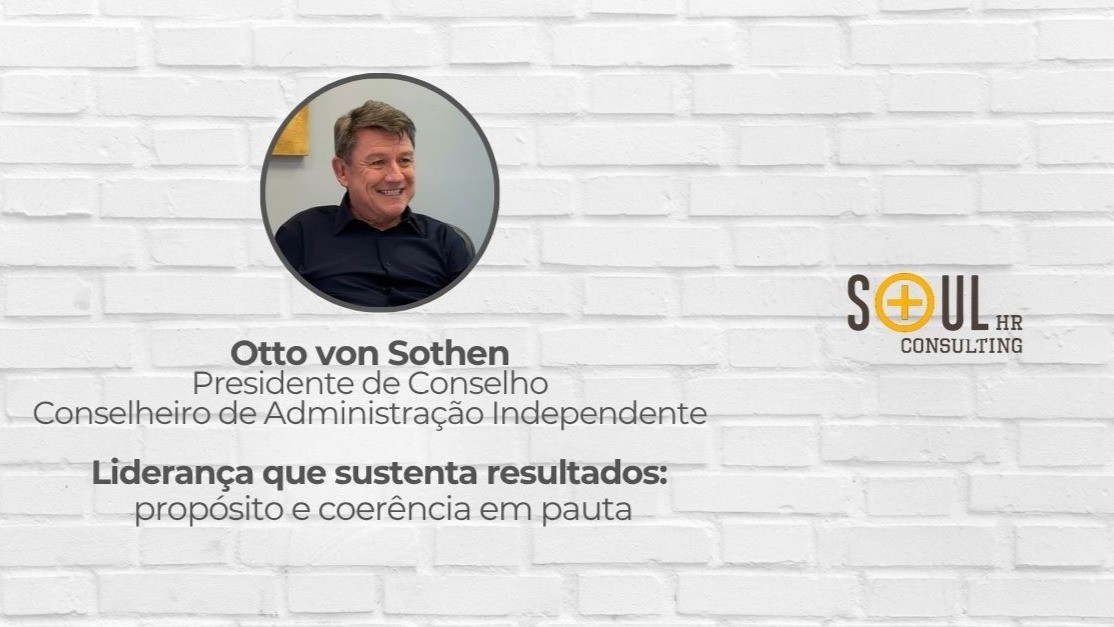
Otto von Sothen, CEO, Board Member and C-Level Mentor, talks about performance, culture and governance on Soul's podcast
Otto von Sothen, a CEO and board member with a career at major global organizations such as PepsiCo, Grupo Tigre and Diageo, took part in the sixth episode of Talk Soul, Soul HR Consulting's podcast, hosted by partner Renata Filippi Lindquist.
In the conversation, the executive shared relevant reflections on leadership, organizational culture and decision-making, highlighting how to balance performance, purpose and responsibility in a corporate landscape marked by constant change and pressure for results.
Otto is currently chairman of the Board of Directors of Baldo S/A and a member of the Statutory Officers Committee of IBGC - Instituto Brasileiro de Governança Corporativa, and has also served on the Advisory Board of UNICEF Brazil.
Leadership and coherence in practice
Otto points out that sustainable results are only possible when there is very strong alignment between words and practice. More than setting targets, the role of leadership is to build environments in which people understand their purpose and find real room to contribute and grow.
For the executive, performance and purpose are inseparable: high performance is only sustained over time when combined with developing people and setting a “high bar”, without ever confusing care with paternalism.
Otto stresses that the challenge for organizations is to create an environment in which people choose to stay, pointing to the 3 Cs that truly determine that engagement:
- Connection: linking the daily routine to a purpose with real meaning;
- Contribution: ensuring that employees' opinions are heard and make a difference to the business;
- Growth (“Crescimento”, the third C in Portuguese): providing continuous progress in learning and career.
After all, leadership is not measured by declared intentions but by its concrete impact on teams' experience. In this context, active listening, transparency and accountability come to the fore as essential competencies for leaders who want to build relationships of trust and engagement.
The role of boards
For Otto, effective boards need to go far beyond demanding financial metrics and compliance routines. When a board limits itself to pressing for numbers without concern for the environment and the culture, it risks encouraging toxic environments that drive away the most qualified professionals. A board member's true value lies in the ability to guide and add value to management, and that means having a broad, comprehensive view, beyond numbers and results.
This role requires raising the level of strategic discussions on agendas that also involve topics such as governance, succession and technology.
In an increasingly complex environment, the quality of these discussions directly influences companies' ability to adapt, innovate and remain competitive.
A new leadership profile
The current scenario demands that models based only on authority and little listening be left behind for good. Otto points out that an executive's greatest obstacle is ego, reinforcing the premise that senior management needs to absorb that “It's not all about you”.
The new leadership profile rests on fundamental pillars:
- Humility and vulnerability: admitting that you do not have all the answers and maintaining transparent communication.
- Consistency between words and action: maintaining day-to-day coherence, since ethical or behavioral lapses quickly break the team's trust.
- Trust and productive conflict: building a safe environment where mutual trust allows open debate and healthy conflict in pursuit of the best decisions.
Leaders who manage to align business vision with human sensitivity tend to build teams that are more engaged, resilient and prepared to sustain the organization's results over time.
The full conversation is available on Talk Soul, the Soul HR Consulting podcast. For more content on leadership, HR and corporate governance, follow Agenda Executiva, Soul's newsletter.