The transformations that have been redefining the business environment demand from companies an ever greater ability to balance operational efficiency, innovation and long-term vision. In this context, the role of Boards of Directors and of leaders becomes even more challenging.
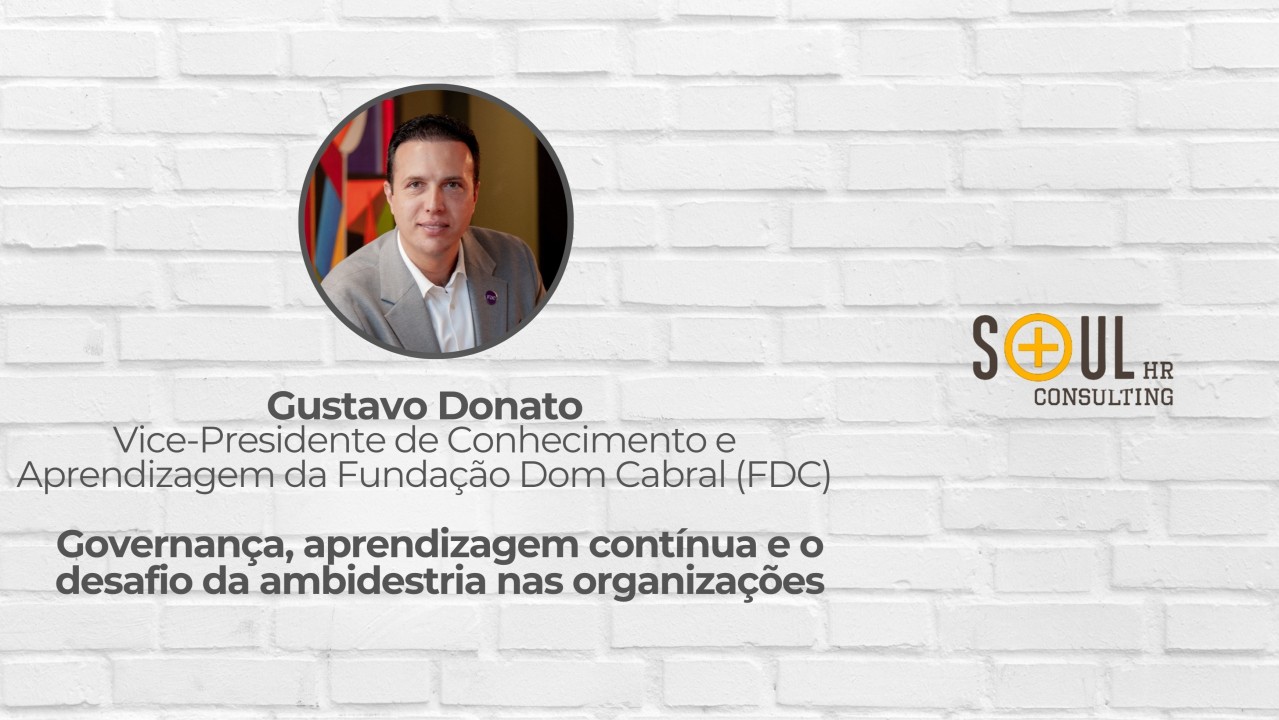
This was one of the main topics addressed by Gustavo Donato, Vice President of Knowledge and Learning at Fundação Dom Cabral and Board Member, in a recent appearance on Talk Soul, the Soul HR Consulting podcast.
Organizational ambidexterity
Throughout the conversation, Gustavo highlighted the importance of developing ambidextrous organizations: capable of delivering consistent results in the present without losing the ability to build the future. To that end, governance plays a fundamental role in ensuring the balance between performance, business sustainability and preparation for the challenges still to come.
In this scenario, topics such as innovation, digital transformation and artificial intelligence have come to occupy a permanent place on Boards' agendas. More than following trends, it falls to governance bodies to understand how these transformations affect organizations' strategy, risks and competitiveness.
According to Gustavo, one of the main challenges lies precisely in the quality of the understanding that leaders and board members have of these new technologies. Without a proper understanding of their applications, limitations and risks, misaligned expectations arise, along with decisions that do not always generate the expected value for the business.
Evolution and staying up to date
The evolution of Boards also involves broadening the diversity of experiences and competencies at the table. In an increasingly complex business environment, the combination of executive experience, technical knowledge, digital repertoire and different generational perspectives strengthens the quality of discussions and decision-making.
Another highlight was the relevance of continuous learning. In a context marked by accelerated change, staying permanently up to date has ceased to be an option and become a necessity. The development of leaders, executives and board members increasingly depends on the ability to learn, unlearn and relearn throughout a career.
The conversation also brought reflections on professional trajectory, career building and the importance of intellectual curiosity as a differentiator for those who want to remain relevant in constantly changing business environments.
More than a discussion about technology or governance, the episode offers a reflection on the future of leadership and on the competencies needed to navigate an increasingly dynamic and complex world.
The full conversation is available on Talk Soul, the Soul HR Consulting podcast. For more content on leadership, HR and corporate governance, follow Agenda Executiva, Soul's newsletter.