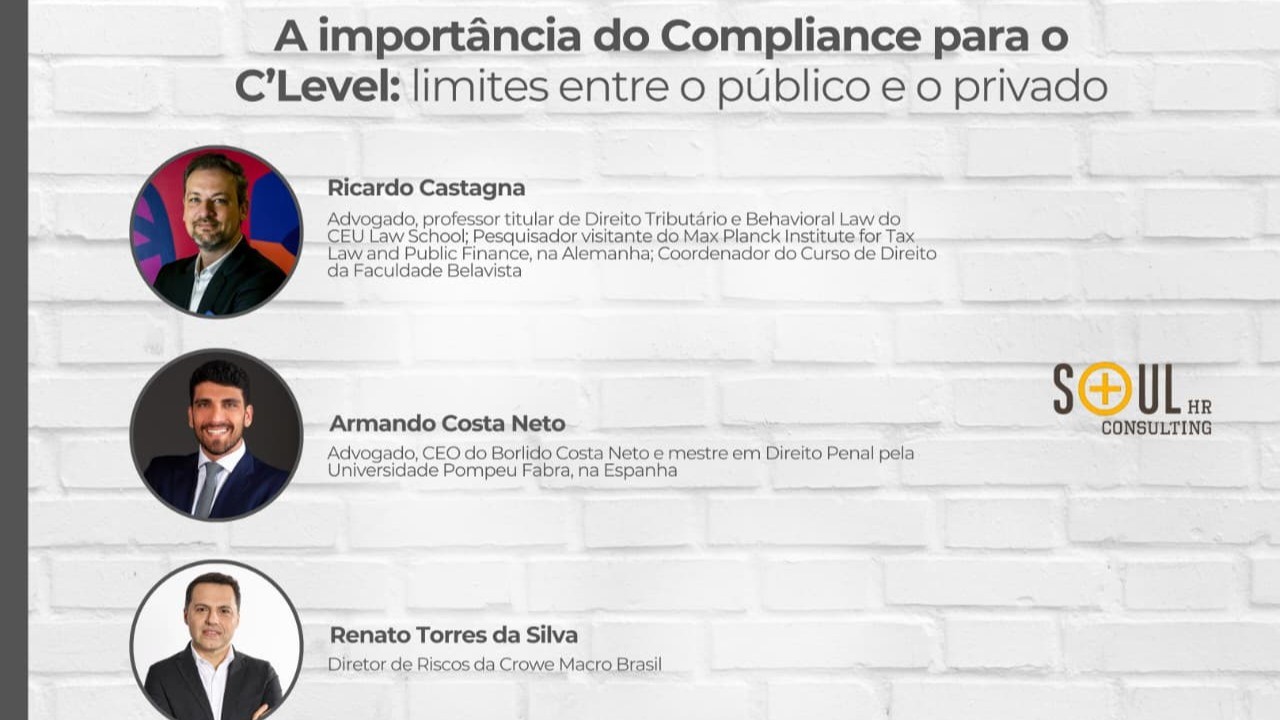
Agenda Executiva spoke with experts Ricardo Castagna, Armando de Oliveira Costa Neto and Renato Torres da Silva to understand how social media affects compliance and senior leadership.
In recent weeks, the news turned to the C-Level, reporting cases of leaders who were dismissed from their companies not because of problems with results or targets, but because of conduct that violated compliance rules. Although the situations differed from one another, they all had one element in common that amplified the dismissals: social media.
That is why, beyond being a tool for connection, social media also raises the following debate: where is the boundary between public and private, and how does that boundary affect Compliance rules and professional conduct?
Reputational exposure
Renato Torres da Silva, Risk Director at Crowe Macro Brasil, explains that “social media has introduced a new vector of risk that goes beyond traditional compliance controls. Where concerns used to be concentrated in areas such as financial integrity, anti-corruption and document governance, today it is essential to also consider reputational exposure in digital environments.”
Ricardo Castagna, a lawyer, full professor of Tax Law and Behavioral Law at CEU Law School and Coordinator of the Law Program at Faculdade Belavista, stresses that social media makes it harder to keep confidential information confidential.
“Conduct problems or any matter relating to confidential information or internal controls used to stay within the company environment. With social media, this has become uncontrolled and diffuse. And, depending on users' interest in a given subject, information spreads at incredible speed and completely out of control”, he points out.
Attitudes that inspire!
Armando Costa Neto, who holds a master's degree in Criminal Law from Pompeu Fabra University in Spain and is CEO of Borlido Costa Neto, recalls that “C-Level executives lead by example and must be the first to comply with, and enforce, their companies' Compliance programs. Senior executives being subject to possible sanctions, including dismissal in serious cases, is fundamental to securing the whole company's adherence to Compliance programs.”
Renato Torres adds that, beyond legal penalties, there is a credibility risk at stake.
“From a reputational standpoint, a crisis caused by an inappropriate post can cost years of brand building. Moreover, we live in an environment where stakeholders, investors, clients, partners and even employees demand transparency, ethics and consistency between words and practice. That is why strict adherence to compliance standards, especially in the digital space, strengthens trust and reduces risks that can affect market value and institutional credibility.”
Lawyer and professor Armando Costa Neto says we should not look at the problem in a polarized way. “Precisely because the boundaries between public and private have become a gray area, we should try to avoid falling into the black-and-white view that exposure on social media will always be bad and that discretion is always good. We have many examples of senior executives who are visible on social media and in the media in general, and that is even part of their management profile.”
Finally, Ricardo Castagna recalls that executives “are responsible for maintaining the company's reputation, so it is mainly from them that measures, strategies and instruments are expected to ensure the company's long-term sustainability in terms of reputation. Trial by social media allows no defense and no due process. So a good career can also be destroyed, depending on how badly the executive fails”, he adds.
How not to fall into traps!
- A clear social media policy: even if a profile is personal, there should be corporate guidance on boundaries, sensitive topics and standards of conduct. Private and public blur together — and the impact on the company's image is inevitable.
- Alignment with organizational culture: leaders must ensure that the positions they take on social media are consistent with the company's values, purpose and principles. This creates brand consistency and credibility.
- Preventive management of digital risks: implement regular training and crisis simulations to deal with the possible repercussions of inappropriate posts. Prevention must be part of the compliance strategy.
- Strategic use of communication: when used well, social media is a powerful asset for reinforcing thought leadership, attracting talent and strengthening ties with stakeholders. The key is to act with responsibility, authenticity and awareness of the reach of your own voice. In short, the role of the CEO and other leaders is not to stay away from social media, but to use it strategically and in line with the principles of governance and compliance, turning this space into a tool for credibility and positive influence.
Enjoyed this content? Be sure to like and share!
Send us, in the comments or by direct message, other topics you would like to see here in our newsletter Agenda Executiva.