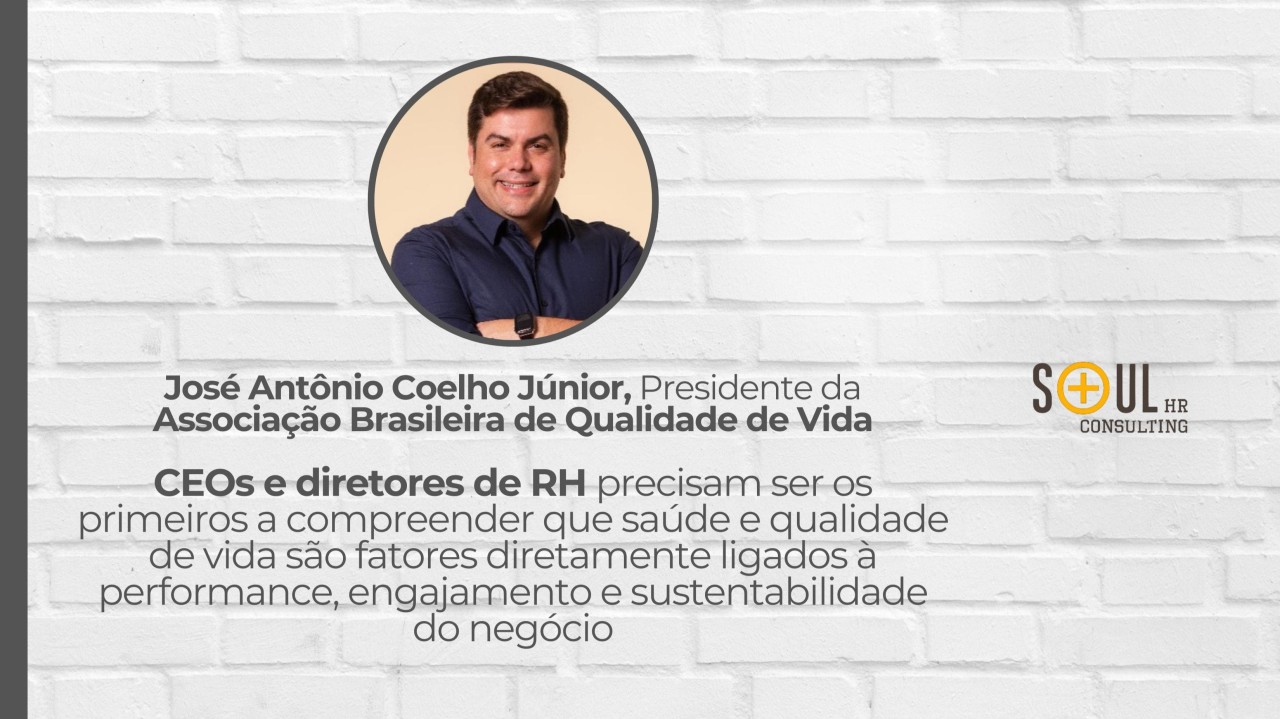
By: José Antonio Coelho Júnior, surgeon, with postgraduate studies in Strategic Management, Leadership and Business Management, and president of ABQV - Associação Brasileira de Qualidade de Vida
Over the 30 years of activity of the Brazilian Association for Quality of Life (ABQV), we have closely followed the evolution of health and well-being in Brazilian organizations. With more than 20 editions of the Brazilian Congress on Quality of Life (CBQV), more than a thousand professionals trained through the MBA in Strategic Management of Health and Quality of Life Integrated with Business, and a positive impact on more than 5 million people through our initiatives, we have built a deep understanding of the transformations and challenges of this ecosystem.
More than a linear trend, well-being in companies goes through continuous cycles of adaptation and evolution. And the starting point lies in the commitment of senior leadership. CEOs and HR directors need to be the first to understand that health and quality of life are factors directly linked to the performance, engagement and sustainability of the business. It is essential to understand what weakens the company: leaves of absence, workplace accidents, excessive sick notes, low productivity. The strategic analysis and management of these indicators, with active C-Level leadership and skilled execution by the HR and Health teams, generate consistent changes — reduced absenteeism, control of health plan claims, talent retention and an improved organizational climate.
Another fundamental cycle is cultural adaptation. Companies with a clear purpose and a relevant social positioning can only sustain that identity when their employees reflect those values. This requires a safe, healthy and inclusive environment, with well-prepared leadership and well-structured policies to sustain a business model on a solid and lasting foundation.
The third cycle is strengthening leadership. Genuinely promoting health in the workplace needs to begin with supporting and developing leaders. When leaders are prepared to listen, support and mediate their teams' needs, psychologically safe and collaborative environments are created. This process needs to be a two-way street: just as important as listening to teams is creating channels so that leaders are also heard, strengthened and equipped to lead with empathy and consistency.
The fourth cycle is governance. Every initiative needs structure, clear policies, well-defined rules and measurable indicators of engagement, productivity, absenteeism and turnover. Communicating this data transparently — such as days without accidents, participation in well-being programs or the number of actions carried out — brings strategy closer to operations, involving every level of the organization.
An element that cuts across all these cycles is the generational challenge. We are about to experience an unprecedented moment, with up to five generations sharing the same workplace: baby boomers, Generation X, millennials, Generation Z and Alpha, each with distinct expectations and ways of relating to work. Communication needs to be diverse, comprehensive, multichannel and inclusive, reaching both digital natives and digital immigrants, ensuring understanding and engagement for all.
In this context, ABQV positions itself as a strategic partner to companies, with the knowledge and tools for implementing best practices and for recognition. The CBQV, which this year reaches its 23rd edition, is the largest national forum for debate on corporate well-being, bringing together experts, leaders and success stories. The Congress will be held from October 6 to 8, in São Paulo–SP, under the theme "ABQV 30 Anos Inovando a Prática da Qualidade de Vida nas Organizações" (ABQV: 30 Years Innovating the Practice of Quality of Life in Organizations). The MBA in Strategic Management of Health and Quality of Life Integrated with Business, in partnership with IESAPM, is in its 18th class, preparing professionals to implement sustainable, business-aligned solutions. The Movimento Gerar Bem-Estar (MGBE) drives companies to promote concrete and transformative actions, and in two years it has reached 227,000 workers with these actions. The Prêmio Nacional de Qualidade de Vida (PNQV), in turn, recognizes and values organizations that lead with responsibility and innovation. The award is reaching its 28th edition, having recognized more than 150 companies, with 2 million lives directly impacted in health and well-being.
More than following trends, we need to lead movements. And ABQV is ready to walk alongside companies on this journey of evolution, purpose and positive impact. Because caring for people is also caring for the future of business.
Enjoyed this content? Be sure to like and share!
Send us, in the comments or by direct message, other topics you would like to see here in our newsletter Agenda Executiva.