
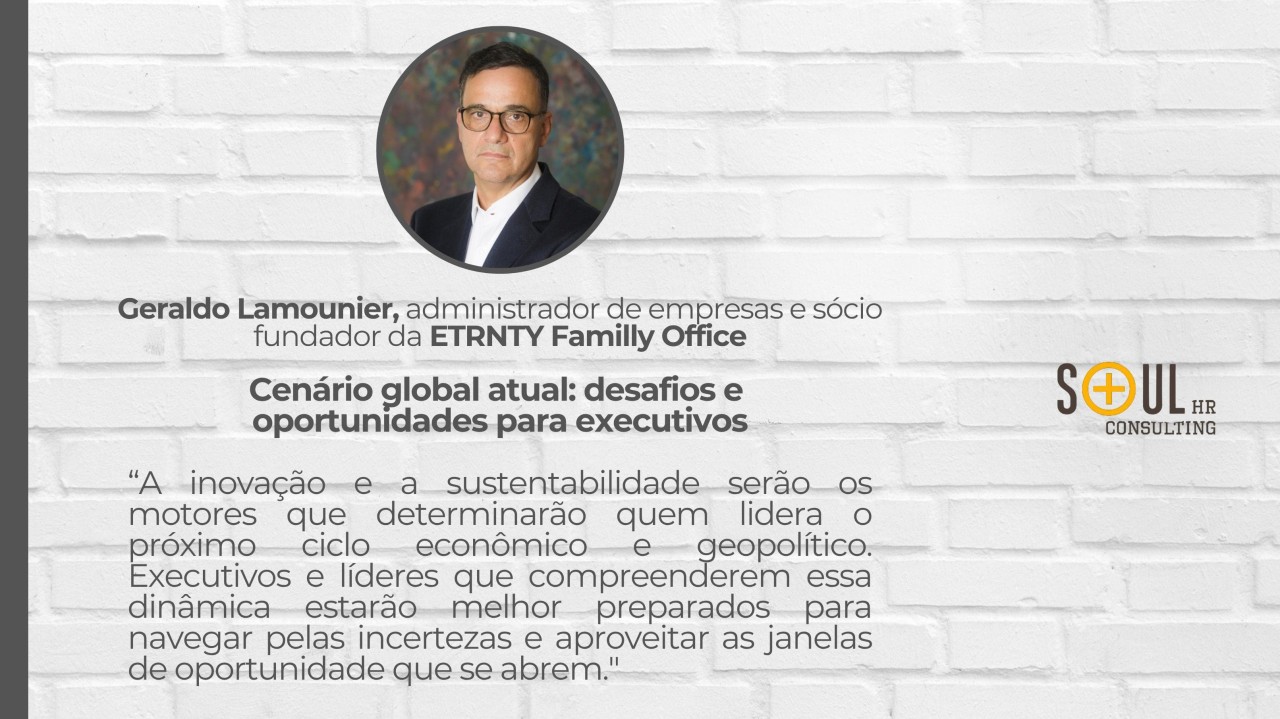
By: Geraldo Lamounier, business administrator and founding partner of ETRNTY Family Office
The global scenario of 2025 sits at a crucial moment, one that can be interpreted in light of the Hegemony and Kondratiev cycles. Kondratiev's theory is based on long waves, of around 50 to 60 years, marked by periods of technological and economic expansion and recession. According to Geraldo Lamounier, founding partner of ETRNTY Family Office, “we are entering a new wave of the Kondratiev cycle, driven by disruptive technological innovations and by a geopolitical reconfiguration that challenges the unipolar model of the 20th century”. This new phase is characterized by the rise of multipolarity, with China and Russia emerging as powers that contest American hegemony, shaping a more fragmented and volatile international environment.
Regional conflicts, such as the war between Russia and Ukraine, which directly affects global energy security, and the tensions in the Middle East involving Israel, Palestine and Iran, along with the risk of nuclear proliferation, highlight the complexity of this new cycle. “We are seeing that disputes over natural resources and the pressure of climate change are not just environmental issues, but central elements of contemporary geopolitics”, Lamounier points out. The relationship between China and Taiwan, with its potential for military escalation, reinforces the instability that permeates this period of transition.
In the economic sphere, the United States faces internal challenges that reflect the dynamics of the Kondratiev cycle. The combination of persistent inflation, high interest rates and a growing nominal fiscal deficit, at around 8% of GDP, puts the country in a delicate position. “Restrictive monetary policy and growing public debt indicate that the US is struggling to adapt to the new global economic paradigm, in which power is being redistributed”. The use of tariffs as a political instrument widens economic fragmentation, forcing companies and governments to reassess their strategies in the face of an increasingly unpredictable global market, and will probably not bring the results expected by the Trump administration.
For Brazil, the challenge is twofold. Domestically, the country lives with inflation, high interest rates, low growth and social and environmental problems that put pressure on its international image. Externally, Brazil has the opportunity to position itself as a central player in the new globalization, drawing on its diversified economy and its diplomacy to act as a bridge between distinct economic and cultural blocs. “Brazil can be the link that connects different worlds, especially in food supply and global food security, strategic sectors in a cycle that values natural resources and sustainable innovation”, says Lamounier.
However, to capitalize on these opportunities, the country needs to overcome its technological and political vulnerabilities, as well as strengthen its leading role in global agendas. The economist stresses: “Innovation and sustainability will be the engines that determine who leads the next economic and geopolitical cycle. Executives and leaders who understand this dynamic will be better prepared to navigate uncertainty and seize the windows of opportunity that open up”.
In short, the world is living through a moment of profound transition, in which Kondratiev cycle theory offers a valuable lens for understanding the transformations under way. Multipolarity, geopolitical tensions, disputes over resources and the technological revolution form a complex mosaic that demands strategic vision, adaptability and leadership. For Brazil and its executives, the challenge is to align their efforts with this new wave, consolidating their relevance and competitiveness on the global stage.
Enjoyed this content? Be sure to like and share!
Send us, in the comments or by direct message, other topics you would like to see here in our newsletter Agenda Executiva.