
An important concept among the measures needed to halt climate change is turning into yet another vague concept with no grounding in reality. And that is a problem!
Arthur Costa Sousa is managing partner of Servtec Energia, Board Member of the Instituto de Energia e Meio Ambiente (IEMA) and Member of CNI's Business Mobilization for Innovation. He was CEO of GDSUN and vice president of Concremat Engenharia e Tecnologia, a company of the Chinese group CCCC.
This article was originally published on May 18, 2024, in the Espaço Aberto section of the newspaper O Estado de S. Paulo.
The climate emergency has brought into the debate a concept that is important in its essence but is being worn out by indiscriminate and mistaken use. There are several important concepts that have become utter commonplaces and turned innocuous in the world of business and government, leaving a concept that is trumpeted to exhaustion without effect, despite the relevance behind it. We are talking about the “energy transition”, a term that has become a kind of global institutional and/or corporate answer in the commitments of governments and/or companies to fight climate change. Quite often, the energy transition is spoken of as a synonym for a low-carbon or zero-carbon (net zero) economy. Clearly, processes of changing energy supply sources in favor of non-fossil alternatives contribute to the pursuit of a low-carbon economy, but it is worth saying that this is not a natural flow, nor as direct as is imagined or advertised.
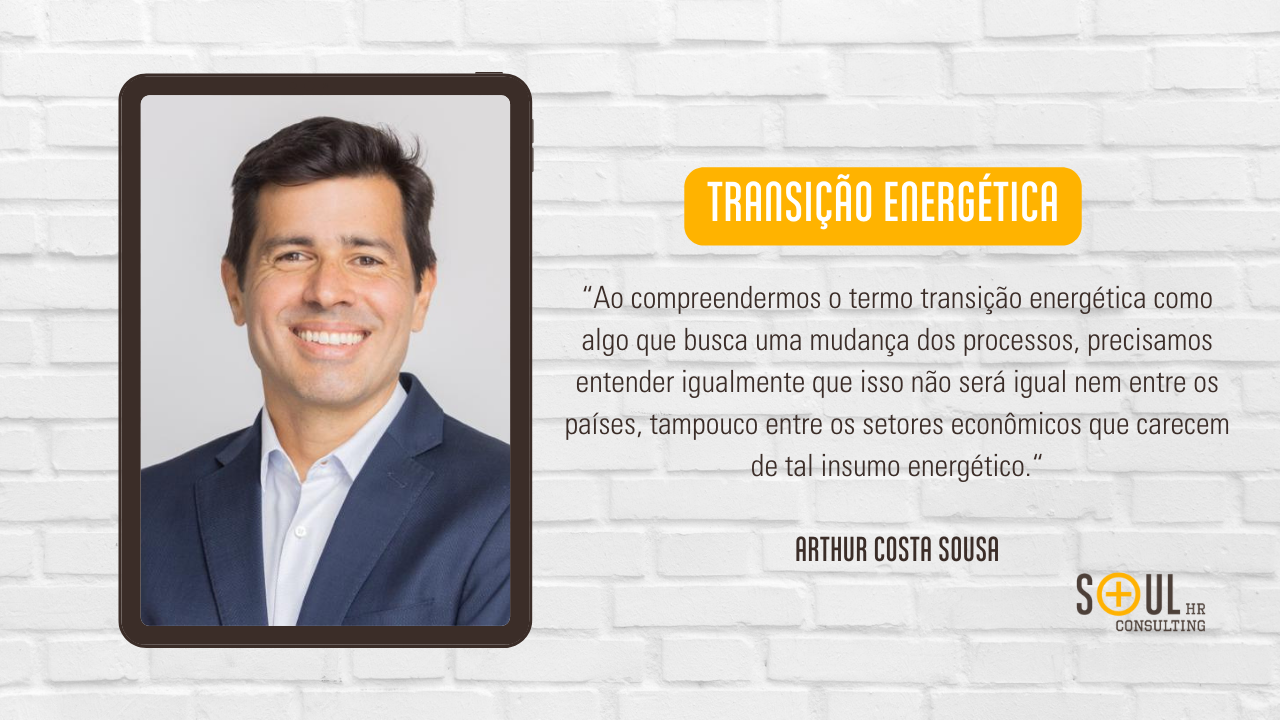
When we understand the term energy transition as something that seeks a change in processes, we must equally understand that this will not be the same across countries, nor across the economic sectors that depend on that energy input.
The energy transition is a concept that can help public and private actors preserve the current global target: holding global warming to 1.5 degrees Celsius, as recommended and guided by the IPCC, in the Paris Agreement. Defining this concept more adequately can even provide a more realistic measure of the effort that each industry, sector, activity or country will be able to offer toward reaching those targets.
Work carried out by the global firm EY shows that mining, metals, oil and gas companies now face an enormous challenge in fitting their supply or production chains into energy solutions that strengthen “the current (energy supply) system” and can allow them to “develop for the future”, when other, more sustainable sources and models will no longer be a challenge but a reality. And each sector or activity faces a different challenge, which requires of each its own adjustment to its limits, its effort and its commitment. As EY notes, the mining and metals sector, for example, is being urged to say why the energy transition cannot be achieved without the mining sector. Let us remember that this is an activity that contributes large volumes of emissions.
Using this term as a synonym for a definitive solution is not realistic. The energy transition can also include subtler changes, such as using natural gas instead of fuel oil to feed a boiler. As you can see, in this case too we are talking about an “energy transition”, although it is not yet a zero-carbon solution.
The perspective of the oil industry or of power generators (renewable or not) will be their own when it comes to the energy transition. Perhaps what these actors regard as the concept of transition is (and almost certainly is) different from what the ordinary consumer thinks, or even the primary, secondary and tertiary sectors of the economy.
Agriculture and the mineral extraction industry, invariably large energy consumers, will tend to understand and need a transition of energy sources in a way very different from manufacturing or even the services sector. A farmer who seeks efficiency in energy use to make irrigation of production areas viable may well be promoting a considerable energy transition in his own micro-environment.
Obviously, this article does not intend to exhaust the discussion of the concept of the energy transition. What it seeks is to propose a reflection on how we should categorize it in this global effort. Brazil currently holds the presidency of the G-20, and it is up to us to set guideposts for a rational discussion of the energy transition.
For decision-makers, understanding the energy transition can avoid the risk of companies betting on unachievable targets. Once such objectives are set, backing away invariably means major reputational damage. Likewise, it is also essential that public authorities, financiers, investors, board members and energy specialists understand the many facets of this challenge and do not take on commitments that simply will not be met.
Understanding the specifics of each will help establish policies, business plans and actions that are fairer and better matched to needs. Of course the pressure for targets exists and will increase, but it is worth thinking carefully about what falls to each party. The energy transition should not be understood as the solution to all of companies' problems regarding energy supply. The energy transition can help a great deal, but it cannot do everything.
Interested in this subject?
Leave in the comments a topic you would like to see in our Agenda Executiva.