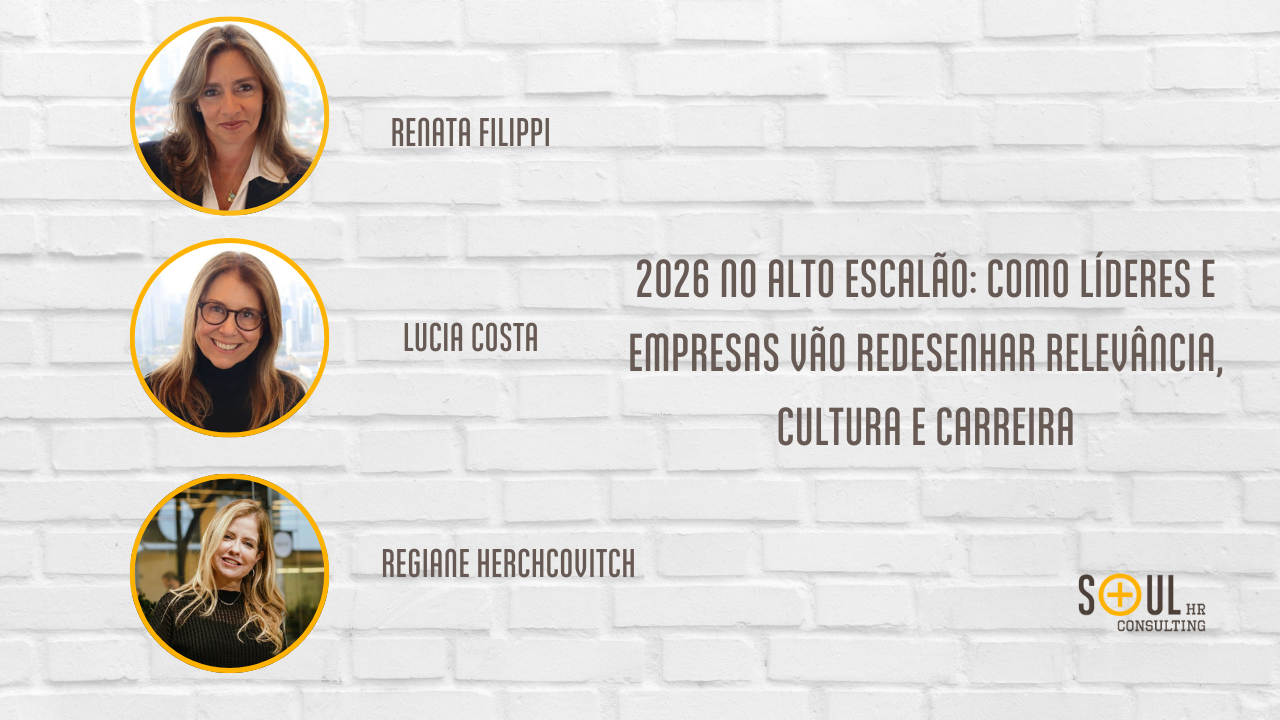
In 2026, Soul HR Consulting reads this movement through three central fronts of its work: leadership selection, career transition and organizational culture, led by Renata Filippi Lindquist, Lucia Costa and Regiane Herchcovitch respectively.
To go deeper into the subject, the three partners of Soul HR Consulting offer, from their areas of practice, a concrete reading of how this scenario reshapes the choices of companies and executives, and which moves will be decisive for navigating the next cycle with consistency.
Renata Filippi Lindquist - Executive Search
What did 2025 change in the way we lead?
The manager focused only on operations and efficiency stopped being enough a long time ago. Those who came to the fore were the ones able to combine business fluency, the ability to engage diverse teams and to get through crises without destroying culture... those able to talk about performance and well-being in the same sentence, with an understanding of the impact of technology and the maturity to decide in ambiguous contexts, testing paths, adjusting course and learning with agility.
Which attributes stopped being differentiators and became requirements?
An owner's mindset with financial discipline, a consistent view of governance and of the environmental, social and governance agenda, as well as a genuine people orientation. These points have become the foundations of conversations with shareholders, boards and CEOs.
How does this translate into Soul's executive search?
What used to be a process of market mapping, interviews and candidate presentation has become a consultative decision journey with real impact in the medium and long term. Selecting leadership today means broadening the view of talent, identifying non-obvious profiles, testing hypotheses across different segments and holding in-depth conversations about career moment, transition, emotional health and purpose.
Robust results remain essential, but it is necessary to show how they were achieved, which decisions were made under pressure and what kind of value was generated for the business. Fluency in artificial intelligence, data and digital transformation has also stopped being a differentiator: executives are not expected to be technical, but to know how to use technology to solve complex problems, redesign ways of working and lead teams in transition.
Lucia Costa - Career Transition
Which career transition challenges became more evident and are likely to intensify in 2026?
The first is repositioning relevance in a more selective and less linear environment: seniority is no longer a passport and becomes a starting point. Boards and committees want to understand real impact, decisions in adverse contexts and the ability to generate value in complex structures.
The second is dealing with time: the market demands agility and availability, while leadership transitions are naturally longer and require preserving inner confidence without giving in to anxiety.
The third is breaking with narratives that have been left behind; presenting yourself only by title and company no longer works.
What changes in the executive's narrative in this context?
The conversation needs to start from the problems the executive knows how to solve and the contributions they can offer to different configurations of the future. Crises to be navigated, businesses to be scaled, cultures to be integrated and delicate turnaround contexts move to the center of the story. The way results were achieved matters as much as the numbers themselves, because organizations want to understand the impact on people, culture and reputation.
A career move no longer means just finding a new position; it comes to mean repositioning identity, voice and place in the professional world.
How does Soul work with the plurality of possible paths?
The same professional may be open to executive positions, strategic advisory work, specific projects or sector transitions. For that breadth to sound coherent rather than diffuse, a degree of inner clarity is needed, which Soul works on in a structured way, integrating deep self-knowledge, the construction of a strategic narrative, market reading and preparation for non-linear trajectories.
Regiane Herchcovitch - Leadership and Culture
Why are culture and leadership so high on the 2026 agenda?
Treating culture as something peripheral to strategy has proved, in practice, unsustainable. In a context of accelerated change, new technologies and constant pressure for efficiency, a culture that is not at the service of the business, guiding decisions, priorities and behaviors, tends to become a risk.
How do you define culture in the day-to-day of organizations?
Culture is not just what can be observed in desirable behaviors but, above all, what is decided under pressure. It is the way people choose to prioritize, communicate, give feedback, recognize, and welcome or not welcome different perspectives.
Cultural change does not happen through argument or inspiring campaigns, but through coherence. People follow what they perceive to be true.
What characterizes consistent cultural change?
Transforming culture is demanding groundwork that combines technique and sensitivity. It involves difficult conversations, a review of habits and a willingness to confront inconsistencies at every level. Leaders cannot act merely as spokespeople for new guidelines; they need to be the living expression of what the organization says it values. Curiosity to learn, consistency between words and practice and the courage to decide on the basis of values, even when that goes against the easiest path, accelerate the building of cultures coherent with the strategy.
Conversely, favoritism, empty words and decisions that offend the sense of fairness quickly erode trust. Without trust, no culture can be sustained.
A year of sensitive decisions
From the organizations' point of view, 2026 is likely to be a year of sensitive decisions, with restructurings, workforce adjustments, business reorganizations and portfolio changes on the horizon for many leaders. In this context, Soul's experience reinforces one conviction: dismissals cannot be treated as a bureaucratic procedure, because the way a company says goodbye reveals a great deal about its character, the maturity of its leadership and the quality of its employer brand.
More humane, transparent and well-structured processes are not a luxury but a reputational investment and a clear signal to those who leave, to those who stay and to the market about the kind of organization one intends to be.
It is from this integrated view that Soul HR Consulting enters 2026, combining analytical depth, human sensitivity and methodological rigor in executive search projects, career transition programs and leadership and culture solutions.
In a year that is likely to test the soundness of management models and the maturity of working relationships, the consultancy positions itself to support companies and executives in the task of aligning strategy, people and culture with consistency, preserving what makes an organization truly sustainable: coherence between what it says, what it decides and what it does, every day.
Did you like this subject? Comment and share the content! Leave in the comments, or send us by direct message, other topics you would like to see here about the world of career, leadership and organizational culture in our newsletter Agenda Executiva.