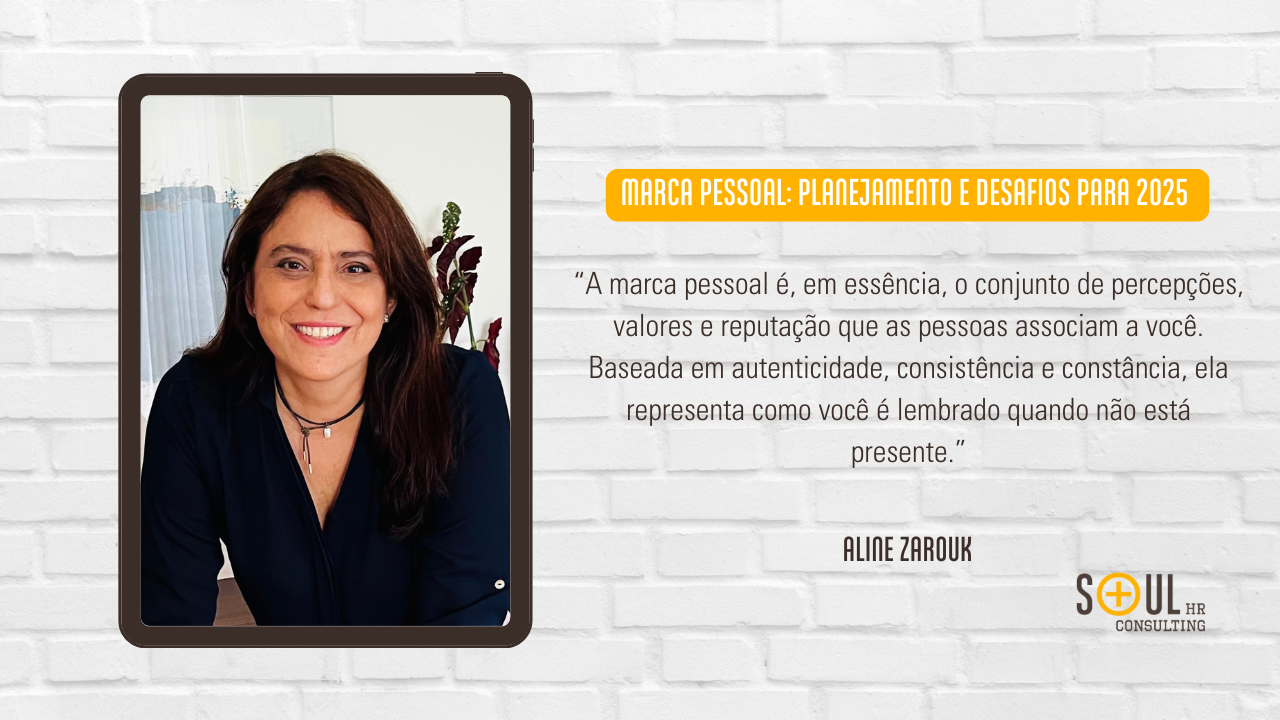
By: Aline Zarouk
Aline Zarouk, our guest this time, has more than 25 years of career experience in new business, strategic planning, branding, marketing, digital and personal branding in the corporate environment, at companies such as Natura, Grupo Pão de Açúcar and Grupo Iguatemi, among others.
She currently works as a CMO as a service, consultant, speaker and mentor.
The start of a new year is always marked by expectations and challenges, especially for executives and companies. After a turbulent 2024, with unstable markets and constant change, the new year always arrives with the promise of new opportunities, but it also demands strategic preparation. In this context, building and strengthening your personal brand become essential tools for professionals who want to stand out and make an impact.
A personal brand is, in essence, the set of perceptions, values and reputation that people associate with you. Based on authenticity, consistency and constancy, it represents how you are remembered when you are not present. Unlike personal marketing, which depends on you highlighting your skills and achievements and can be a one-off action, a personal brand goes deeper: it reflects the essence of who you are, your values and the impact you have on the environment around you, and it depends on others. In challenging times, it is this essence that sustains reputation and creates genuine connections.
A New Year, a New Look at Your Brand
The turn of the year is an opportunity to revisit and work on your personal brand. For that, self-knowledge is the starting point.
Ask yourself:
• What are my core values?
• What sets me apart in the market?
• How do I want to be remembered by colleagues, partners and clients?
• Does my current narrative reflect who I am and what I am looking for?
Answering these questions helps align your identity with the way you communicate and act, both in the physical and in the digital environment. In 2025, a year that promises fierce competition and constant innovation, having clarity about your brand will be a significant differentiator.
Inside the Company: Personal Brand and the Corporate Environment
For those working as executives in a company, strengthening your personal brand means not only standing out individually but also aligning yourself with the organization's values. Today, people are more than "So-and-so from company X"; they have their own stories, skills and unique contributions. Even so, it is essential that there be balance between your personal brand and the corporate culture.
Some tips for building a strong brand within the organization include:
• Align values: Make sure your principles are in harmony with the company's.
• Be consistent: Keep your words and actions coherent.
• Show impact: Focus on how your actions benefit the organization and your colleagues.
Remember: everything communicates. From your posture to the way you contribute in meetings, everything reflects your brand and the way you will be perceived by others.
Overcoming Challenges and Aligning Perceptions
In a market now saturated with information, making sure others see you as you wish to be seen is essential. This alignment requires authenticity and consistency. To achieve it:
• Highlight what sets you apart: It may be your innovative approach, your ideas or your ability to solve problems. Do not write just because something is the topic of the moment, but because the subject reflects your opinion and relates to you.
• Invest in digital and physical presence: Share relevant content, take part in discussions on social media and be present at strategic events. Build relationships!
• Build trust: Trust is born of authenticity and of constant interactions aligned with your values. Whether in the corporate environment or in career transitions, your personal brand is the foundation for opening doors and building lasting relationships.
Career Transitions: Positioning Your Brand
For professionals seeking a new position, a well-structured personal brand is indispensable. It highlights your differentiators and positions you as the ideal solution for the market. More than listing competencies, you need to demonstrate how your skills generate value.
Rebuilding/repositioning your image is also possible. It begins with an honest diagnosis, identifying what needs to be adjusted and what you want to communicate from now on. Develop a consistent strategy that includes feedback from mentors or colleagues, adjust your professional interactions and reinforce the narrative you want to promote, whether through social media, networking or strategic projects. It is a process that takes time and authenticity, but it is entirely feasible. You do not need to disregard your previous image, which brought you countless lessons, but you will focus more on your strengths, attitudes, posture and communication, and over time this work will gain consistency and weight.
As with the concept of lifelong learning, personal branding is a continuous construction. It keeps pace with your professional evolution and adaptations, ensuring that you are always relevant and aligned with market demands. The English term is especially fitting because it is a gerund, highlighting ongoing management as the key point.
Leadership and Its Reflection on the Organization
Leaders, especially C-levels, have an additional responsibility: their personal brand directly impacts the company's branding. When well built, it strengthens corporate reputation, attracts talent and builds trust among stakeholders.
To that end, it is essential to:
• Embody the company's values: Aligning decisions and communications with the organizational culture.
• Demonstrate authentic leadership: Showing consistency between words and actions.
• Build authority: Taking part in relevant debates and positioning yourself as a reference in the sector.
In times of rapid change, leaders who invest in their personal brands help guide companies and teams with greater confidence and credibility.
Companies and the Development of Their Executives' Personal Brands
Organizations play an important role in strengthening their leaders' personal brands. They can promote initiatives such as:
1. Self-knowledge workshops: Helping executives identify their values and unique skills.
2. Communication training: Aligning personal messages with the company's vision.
3. Storytelling: Teaching leaders to use narratives to connect emotionally with their teams and stakeholders.
The Role of Storytelling in Personal Branding
Storytelling is a powerful tool. It creates emotional connections and highlights your uniqueness. By telling your story authentically, you make your brand memorable and engaging. In 2025, with so many voices competing for attention, having a clear and captivating message will be a competitive advantage.
Practical Tips for 2025:
To conclude, the logic of personal branding is based on the idea that we all leave a mark, deliver value and make a promise to the world. Every interaction, whether in person or virtual, communicates something about who you are.
In short, here are seven essential steps to strengthen your personal brand:
1. Self-knowledge: Know who you are and what you want to convey.
2. Consistency: Align actions and messages across all channels. 3. Differentiation: Highlight what makes you unique.
3. Authenticity: Be true to your values in every interaction.
4. Networking: Build genuine and intentional connections.
5. Digital presence: Reinforce your brand on social media.
6. Continuous evolution: Adjust and improve your brand as you advance in your career.
Investing in your personal brand is investing in the future. In an increasingly competitive market, it is your foundation for growth, impact and relevance. Set aside some time for your brand; it deserves it!
Interested in this subject?
Leave in the comments a topic you would like to see in our Agenda Executiva.